


Sinkholes don’t dominate Ontario’s geological risk list the way they do in Florida or parts of the American Midwest. But they happen here — and when one opens beneath your property, the consequences are sudden, expensive, and poorly understood by most homeowners. Knowing the early warning signs can mean the difference between a manageable repair and a catastrophic loss.
What Causes Sinkholes in Ontario?
A sinkhole forms when underground material — usually soluble bedrock like limestone, gypsum, or dolostone — dissolves over time, leaving a void that the surface eventually collapses into. Ontario’s geology includes pockets of these formations, particularly in parts of Southwestern Ontario and along the Niagara Escarpment.
But natural geology isn’t the only cause. In urban and suburban areas, sinkholes often develop from:
- Broken or deteriorating water and sewer lines that wash away supporting soil
- Old, unmapped wells or cisterns on former agricultural land
- Poorly compacted fill from past construction or demolition
- Changes in groundwater levels from nearby development, drought cycles, or municipal pumping
In some cases, a sinkhole that appears suddenly was actually developing underground for years — with warning signs that went unnoticed.
Indoor Warning Signs
Sinkhole activity often reveals itself inside your home before anything dramatic happens outside. Pay attention to these subtle changes:
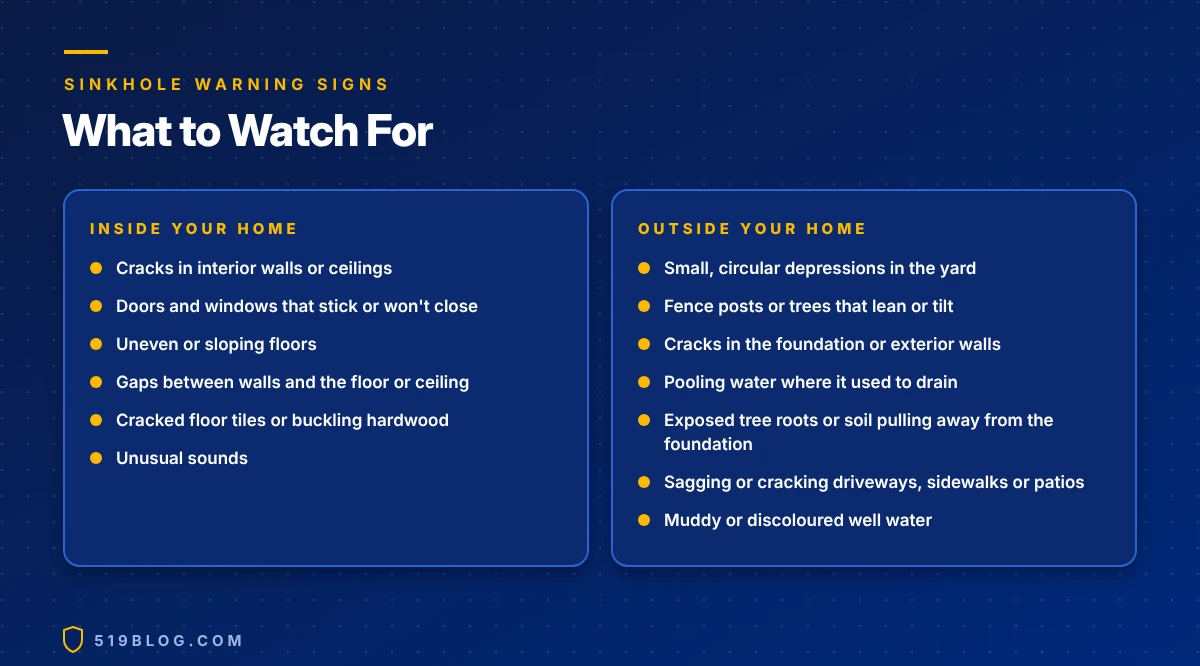
- Cracks in interior walls or ceilings — especially diagonal cracks near door frames or windows, or cracks that grow wider over weeks
- Doors and windows that stick or won’t close properly — if a door that always worked fine suddenly won’t latch, it may indicate the frame is shifting
- Uneven or sloping floors — place a marble on the floor in different rooms; if it rolls consistently in one direction, you may have differential settling
- Gaps between walls and the floor or ceiling — visible separation where surfaces should meet flush
- Cracks in floor tiles or buckling of hardwood — particularly in areas away from moisture sources (so it’s not a humidity issue)
- Unusual sounds — some homeowners report creaking, popping, or grinding noises from beneath the floor or inside walls as structural components shift
None of these signs on their own confirm a sinkhole. Many are also associated with normal foundation settling, frost heave, or even plumbing issues. The key is pattern recognition — multiple signs appearing together or worsening over a short period.
Outdoor Warning Signs
Outside the house, sinkhole activity tends to be more visible — if you know what to look for:
- Small, circular depressions in the yard — especially ones that appear suddenly or grow over time
- Fence posts, trees, or other structures that lean or tilt — when objects that were once vertical start to angle, the ground beneath them may be moving
- Cracks in the foundation or exterior walls — particularly stair-step cracks in brick or block foundations
- Pooling water in areas that previously drained well — a change in surface drainage can indicate underground void formation
- Exposed tree roots or soil pulling away from foundations — ground that appears to be “sinking” relative to fixed structures
- Sagging or cracking of driveways, sidewalks, or patios — concrete slabs that drop, crack, or develop gaps at joints
- Muddy or discoloured well water — if you’re on a well, sudden changes in water clarity can indicate underground soil movement
In rural Ontario properties — particularly older ones with barns, outbuildings, or former wells — watch for unexplained soft spots in the ground. These can indicate old, collapsing underground structures.
Does Ontario Home Insurance Cover Sinkholes?
Here’s the hard truth: standard Ontario home insurance policies generally do not cover damage caused by sinkholes. Most policies contain an exclusion for “earth movement,” which includes sinkholes, subsidence, mudslides, landslides, and earthquakes.
There are a few important nuances:
- If a covered peril causes the sinkhole — for example, if a burst water main (a covered loss) washes away soil and creates a sinkhole — your insurer may cover the resulting damage. But the sinkhole itself isn’t covered; it’s the water damage from the burst pipe that triggers the claim.
- Earthquake endorsements don’t typically extend to sinkholes. Earthquake coverage and ground movement coverage are not the same thing.
- Some specialty insurers or Lloyd’s of London markets offer ground subsidence coverage, but it’s uncommon, expensive, and typically only sought by commercial property owners or homeowners in known risk areas.
If you suspect your property is in an area with sinkhole risk — near old mines, quarries, or areas with known karst geology — talk to your insurance broker about your options. At the very least, you’ll understand exactly what your policy does and doesn’t cover.
→ Get a home insurance quote to review your current coverage.
What to Do If You Suspect a Sinkhole
If you notice several of the warning signs above — especially if they’re appearing or worsening quickly — take these steps:
- Document everything. Photograph cracks, depressions, leaning structures, and any changes in your home. Note dates when you first observed each issue.
- Contact your municipality. Report the concern to your local building department or public works office. They can check municipal infrastructure (water mains, storm sewers) that might be contributing to the problem.
- Hire a geotechnical engineer. A qualified engineer can assess your property, conduct soil testing, and determine whether ground movement is occurring. This is the only way to confirm a sinkhole.
- Notify your insurance broker. Even if your policy doesn’t cover sinkholes, your broker should know about the situation. There may be related coverage that applies, and early notification protects your interests.
- Stay cautious. If ground movement appears active — visible sinking, rapidly growing cracks, or sudden depressions — err on the side of safety. Keep people and pets away from affected areas until a professional assesses the situation.
The Bottom Line
Sinkholes are uncommon in Ontario, but they’re not unheard of — and when they happen, the damage is often severe and largely uninsured. The best defence is awareness: knowing what causes them, recognizing the warning signs early, and understanding what your insurance does and doesn’t cover.
If you have questions about sinkhole risk or want to review your home insurance policy for earth movement exclusions, reach out.
Questions? Call or text Matt Santagapita at 226-777-2403 or email [email protected].
Disclaimer: This article is intended for informational purposes only and does not constitute professional insurance advice. Coverage varies by policy. Always consult with a licensed insurance broker for advice tailored to your specific situation.
