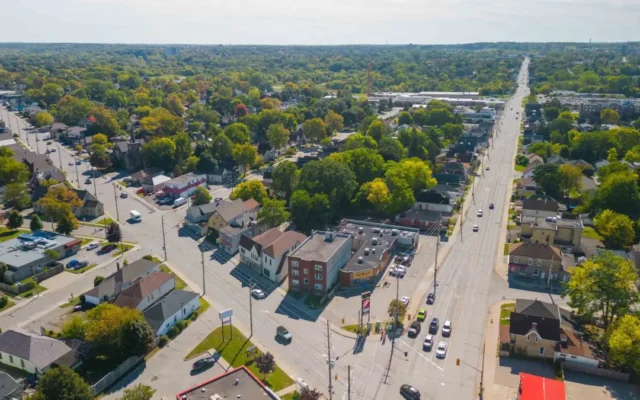
Byron has a trick to it: it’s part of London, but it doesn’t quite feel like it. This large southwest neighbourhood has held onto a small-town, village atmosphere — sidewalk patios, a strong sense of community, and the kind of place where you run into people you know at the grocery store. Add a ski hill, one of the biggest parks in the city and a children’s storybook attraction, and it’s easy to see why Byron is one of London’s most popular family neighbourhoods. Here’s what living in Byron is actually like.
Where is Byron?
Byron sits in London’s southwest end, roughly bounded by Southdale Road West, Byron Baseline Road and Commissioners Road West, with the Thames River curling along its edge. It was a separate village before becoming part of London in the 1960s, and that history is a big part of why it still feels like its own place. The neighbourhood centres on the Commissioners-and-Boler commercial node and spreads out into quiet residential streets and newer subdivisions toward the city’s edge.
The homes
Byron offers a broad mix of housing, from established post-war homes on mature, treed lots near the village core to newer subdivisions on its western and southern edges, along with townhomes and apartments closer to the commercial areas. Neighbourhood data for the broader Byron area shows a base that’s roughly three-fifths single-detached homes, with about a fifth townhouses and row housing and the balance in apartments closer to the commercial core — and it’s strongly owner-occupied, on the order of three-quarters. The building eras span the decades, from mature 1960s–80s streets near the village to newer construction toward the city’s edge. That range is part of the appeal — it’s a neighbourhood people move within as their needs change, rather than leaving: a young family might start in a smaller home near Springbank Park and later move up a few streets over without ever leaving Byron.
The big draw: parks and recreation
This is where Byron really shines, and it’s worth spelling out.
Springbank Park is one of London’s largest and most-loved parks — more than 300 acres of riverside walking paths, picnic areas, gardens and playgrounds stretched along the Thames. It’s also home to Storybook Gardens, the children’s amusement park that generations of London kids have grown up with, open seasonally with rides, a splash pad and a winter skating trail.
Boler Mountain gives Byron something almost no other city neighbourhood has: a ski and snowboard hill right in the neighbourhood in winter, plus mountain biking, tubing and a treetop adventure park (the Wild Zipline & Aerial Adventure Park) the rest of the year. Having a genuine four-season recreation hill inside city limits is a real Byron signature.
Jorgenson Park rounds it out with the Byron Optimist Community Centre, a wading and swimming pool, tennis courts, soccer fields, baseball diamonds and play structures.
Beyond the marquee attractions, the wider Byron area is generously supplied with everyday green space — on the order of a dozen parks and dozens of recreational facilities, from playgrounds and sports fields to tennis and basketball courts, ball diamonds, splash pads and kilometres of trail along the Thames.
Schools
Byron is well set up for families, and its schools carry real history. On the public side, Byron Northview Public School (JK–8, Thames Valley DSB) sits on one of the oldest school sites in southern Ontario — a school has stood here since the 1830s, and the 1852 cobblestone schoolhouse still marks the spot; it took the Byron Northview name in 1961 when the village of Byron was annexed into London. Byron Southwood and Byron Somerset public schools round out the elementary options. For high school, students head to Saunders Secondary School (grades 9–12), built in 1972, named after Canadian agriculture pioneer William Saunders, and the largest secondary school in the Thames Valley board — known for a province-leading apprenticeship stream. Catholic families have St. George and St. Theresa elementary schools nearby, with St. Thomas Aquinas Catholic Secondary as the high-school option. The Byron branch of the London Public Library is on Commissioners Road.
Shopping and amenities
Byron’s commercial heart is the intersection of Commissioners and Boler Roads, anchored by a grocery store and lined with shops, services and — a Byron signature — sidewalk patios where residents linger over coffee and dinner. A secondary commercial pocket sits near Boler and Byron Baseline. It’s enough day-to-day shopping that you rarely need to leave the neighbourhood, though the larger west-end retail districts are a short drive away.
Getting around
Byron is a drive-first neighbourhood — it’s on the edge of the city with quick access to Commissioners and Wonderland Roads and the highway network beyond — but it’s served by London Transit, and the commercial core is genuinely walkable once you’re in it. The Thames Valley Parkway also gives cyclists and walkers a car-free route toward Springbank Park and the rest of the city’s trail network.
Neighbourhood data confirms the drive-first pattern — roughly nine in ten commuters travel by car — though London Transit serves the area with dozens of stops, and the Thames Valley Parkway gives walkers and cyclists a car-free route toward Springbank Park.
Who Byron is best for
Byron is a classic family neighbourhood, and that’s who it suits best: parents who want good schools, big parks and a safe, community-minded place to raise kids. It also appeals to outdoor-minded buyers of any age — the combination of Springbank Park, the Thames trails and Boler Mountain is hard to match anywhere else in the city — and to move-up buyers who want a newer, larger home on the southwest edge. The main trade-off is distance: Byron is farther from downtown and Western University than the central neighbourhoods, so it’s more car-dependent for work and nightlife.
Nearby neighbourhoods
Considering the southwest end? Compare Byron with Cadeau next door, Oakridge to the north, Riverbend across the river, and Lambeth to the south.
Frequently asked questions
Is Byron a good place to live in London, Ontario? Byron is one of London’s most popular family neighbourhoods, known for its small-town feel, excellent parks (Springbank Park, Boler Mountain, Storybook Gardens), good schools and a walkable commercial strip along Commissioners and Boler.
Does Byron have a ski hill? Yes — Boler Mountain, right in Byron, offers downhill skiing and snowboarding in winter, plus mountain biking, tubing and a treetop adventure park in the warmer months.
Is Byron part of London, Ontario? Yes. Byron was once a separate village but is now a neighbourhood within the City of London’s southwest end, though it retains a distinct small-town character.
Is Byron good for families? Very much so — it’s one of the go-to family neighbourhoods in London, thanks to its schools, its parks and playgrounds, and a strong community association and sense of neighbourliness.
How far is Byron from downtown London? Byron is on the southwest edge of the city, roughly a 15-to-20-minute drive from downtown depending on traffic, which is the main trade-off for its quieter, greener setting.